Mitchell Langley EspaƱol

Case studies

Infrastructure finance, regulatory strategy and land use

Seven projects from my advisory work, combining financial modeling, legal review and operating data. Each one sets out the mandate, the analysis and the outcome.

Site Feasibility & Project Implementation

Electric Bus Depot Relocation & Charging Strategy

Mandate

Assess a mandatory government-owned charging site after award of an electric bus operating contract, and develop a site-replacement strategy addressing land control, permitting, implementation timing and fleet charging requirements.

Outcome

The contracting authority approved a waiver of the mandatory site requirement, and the project started on time.

Analysis

Established that the mandatory parcel lacked public-road frontage, utility connections, and clear possession rights, with complex land-merger and environmental hurdles making the contractual deadline impossible to meet. Documented these fatal constraints to invoke the contract's express site-substitution provision. Proposed relocating the full fleet into an existing intercity terminal, verifying its existing building approvals, land rights, and shared-power charging configuration to ensure a timely launch.
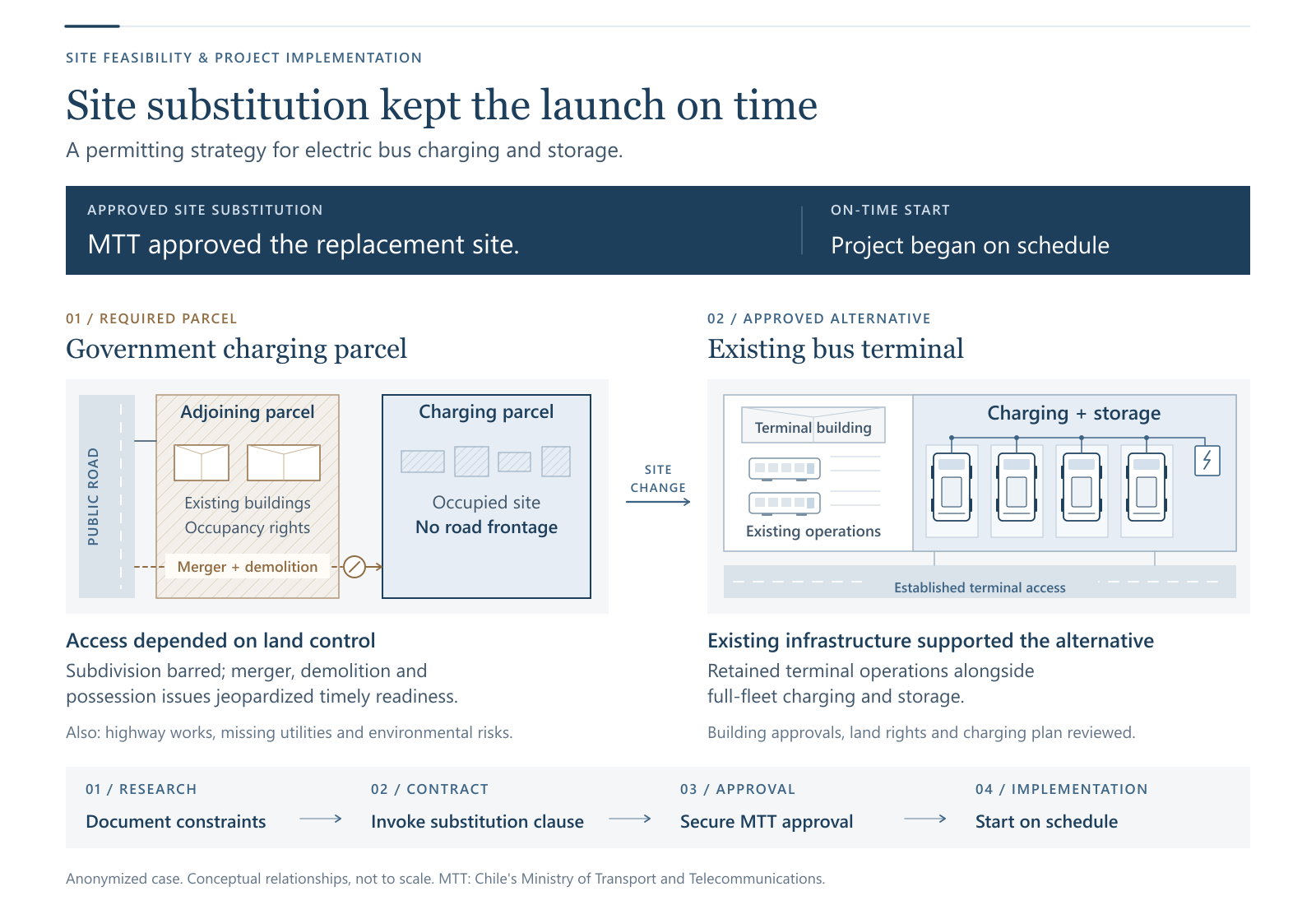
Depot relocation strategy: a comparison of the proposed site against the mandatory requirement. The strategy outlines a phased approach to site substitution and implementation. View full size

Lender-Side Due Diligence

Electric Bus Fleet & Charging Infrastructure Lease

Mandate

Retained by a project financier to evaluate a regional transit operator's financing request, including regulatory compliance, site control, and operating assumptions.

Outcome

The financier declined to proceed.

Analysis

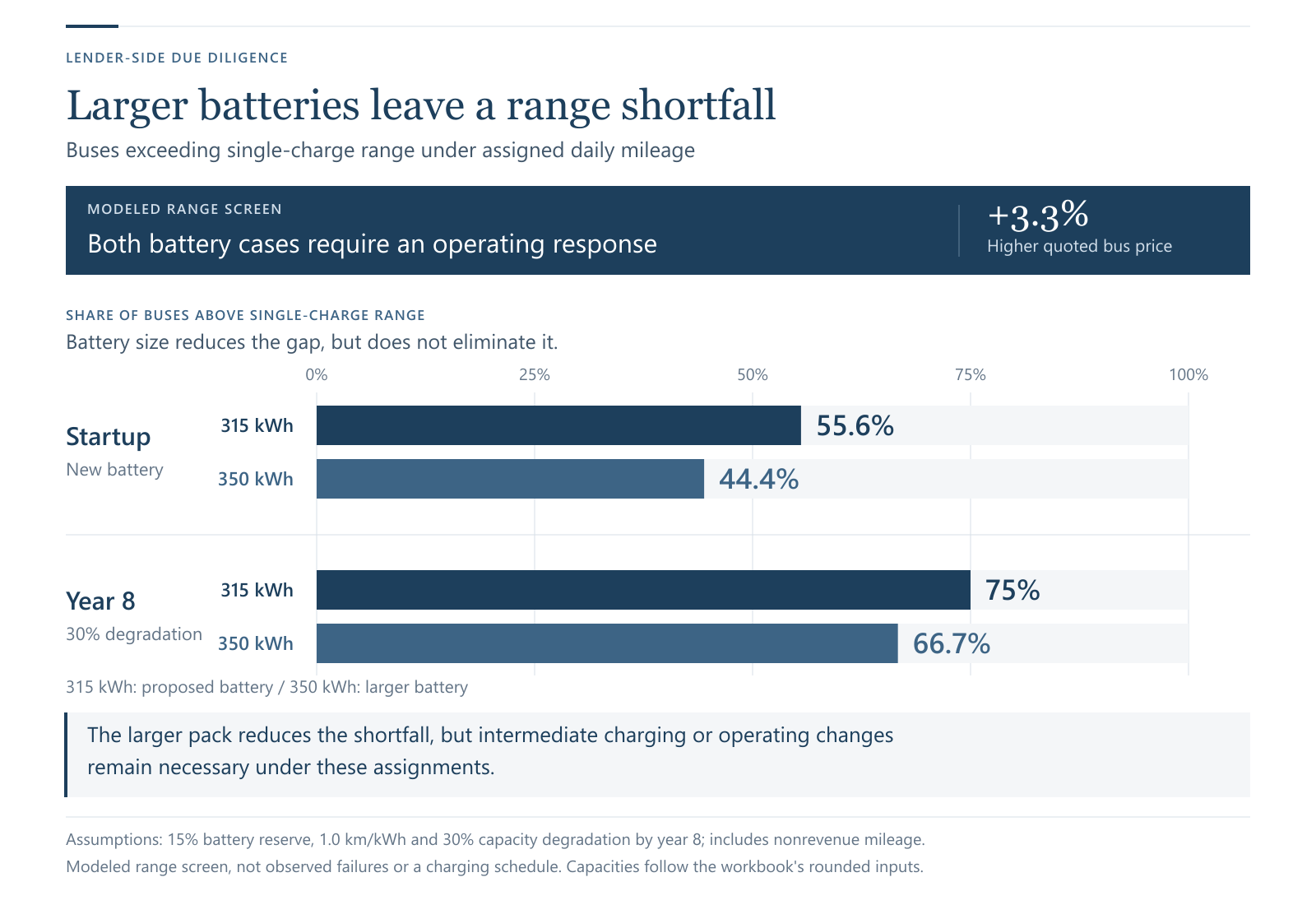
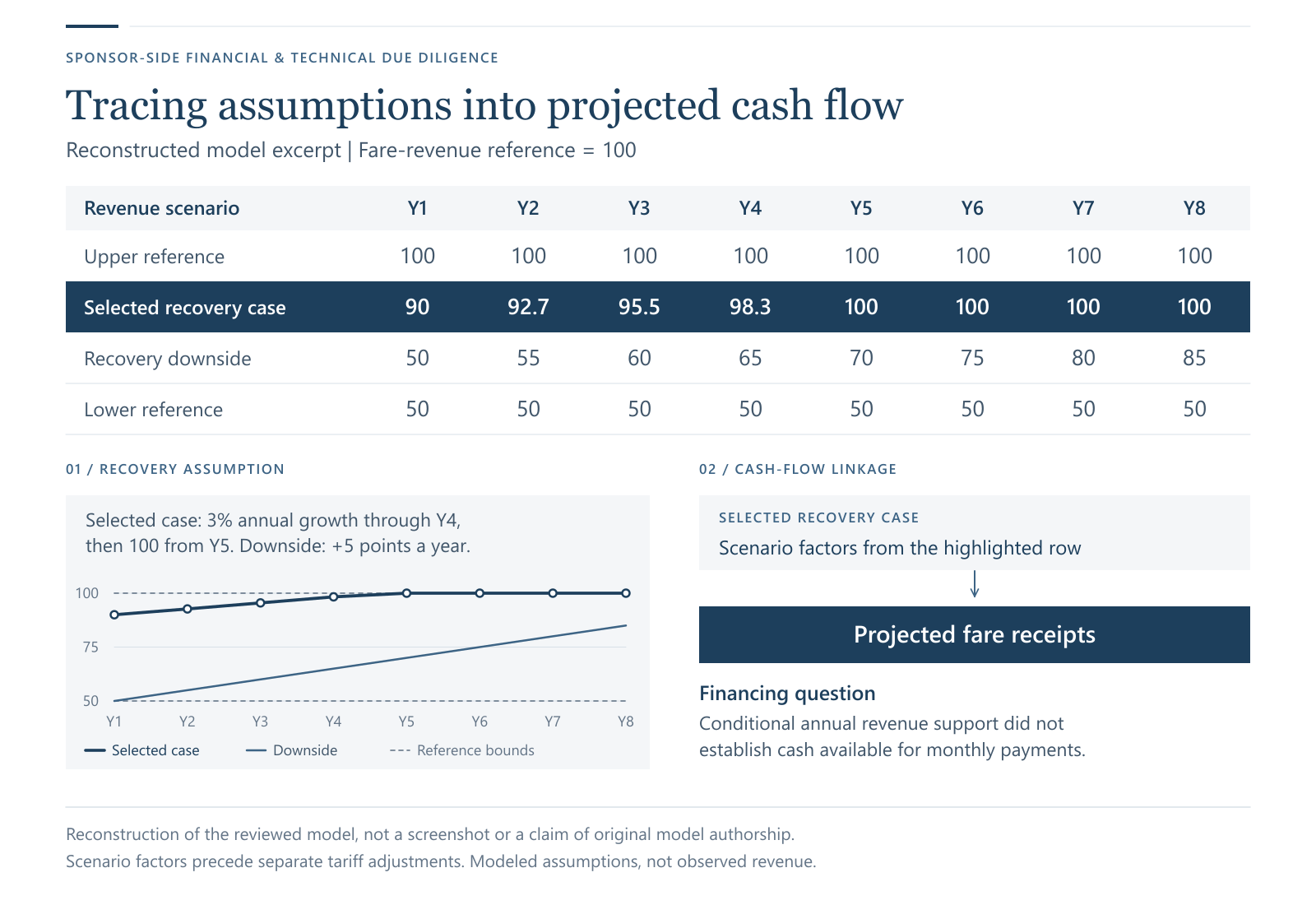
Established that the land-use approval submitted to support the financing request had expired under its stated validity period, that the municipal certificate showed the proposed use was not permitted, and that the property was subject to three reservations for future public taking. Tested the model under three battery-performance assumptions and showed that the proposed fleet could not meet the regulator's service requirements even under the most favorable energy-consumption assumption. Identified an internal contradiction between the cash-flow model's assumptions about revenue receipts and regulatory compliance.

Lender-side battery range review: the share of buses whose assigned daily mileage exceeds single-charge range. The proposed battery case rises from 55.6 percent at startup to 75 percent in year eight; the larger battery case rises from 44.4 to 66.7 percent. Modeled with a 15 percent reserve and 30 percent capacity degradation by year eight. View full size

Contract Negotiation & Risk Analysis

Service-Startup Delay & Fleet Financing Exposure

Mandate

Retained by a concessionaire to quantify the financial, technical, and administrative exposure of the operator and its financier if service startup were delayed, and to present and defend the analysis before the regulator.

Outcome

The regulator issued an interpretation allowing the full government-backed monthly fleet payments to begin when partial service started, rather than prorating payments based on the number of buses in service.

Analysis

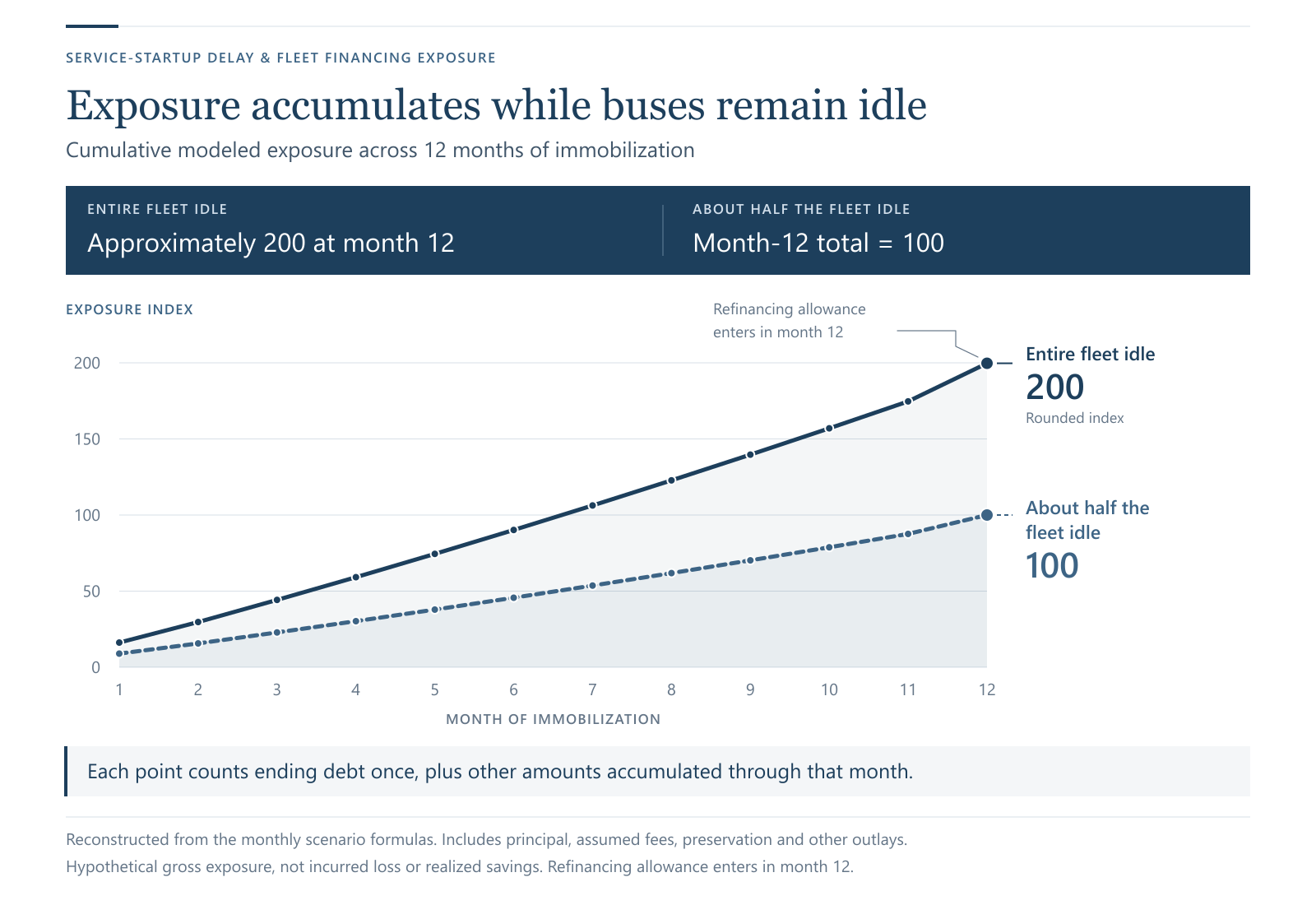
Built and evaluated two 12-month scenarios in which part or all of the fleet remained out of service. Assessed fleet lease payments that would remain due during the delay, preventive maintenance requirements, vehicle storage costs, charging infrastructure maintenance, and other continuing costs. Recommended early debt restructuring negotiations with the fleet supplier and coordinated maintenance procedures to preserve vehicle condition during storage.

Cumulative startup-delay exposure: two 12-month modeled paths. The partial-fleet case ends at index 100 and the full-fleet case at approximately 200, each point combining ending debt and other amounts accumulated to that month. View full size

Regulatory & Policy Analysis

Bus Fleet Replacement Subsidy Program

Read writing sample

Mandate

Retained by an industry group to evaluate whether a bus replacement subsidy program's selection criteria accounted for mandatory vehicle retirement ages in the city.

Outcome

Local transit operators and the regional government are using the analysis of mandatory retirement requirements to seek additional national government funding.

Analysis

Analyzed the age distribution of the city's bus fleet using official vehicle registration data and compared the funding round's selection results with mandatory vehicle retirement requirements. Calculated the funding needed for an additional round of bus replacements to meet those requirements. Prepared a legal brief outlining the regional government's statutory authority to prioritize the city's buses in an additional funding round.

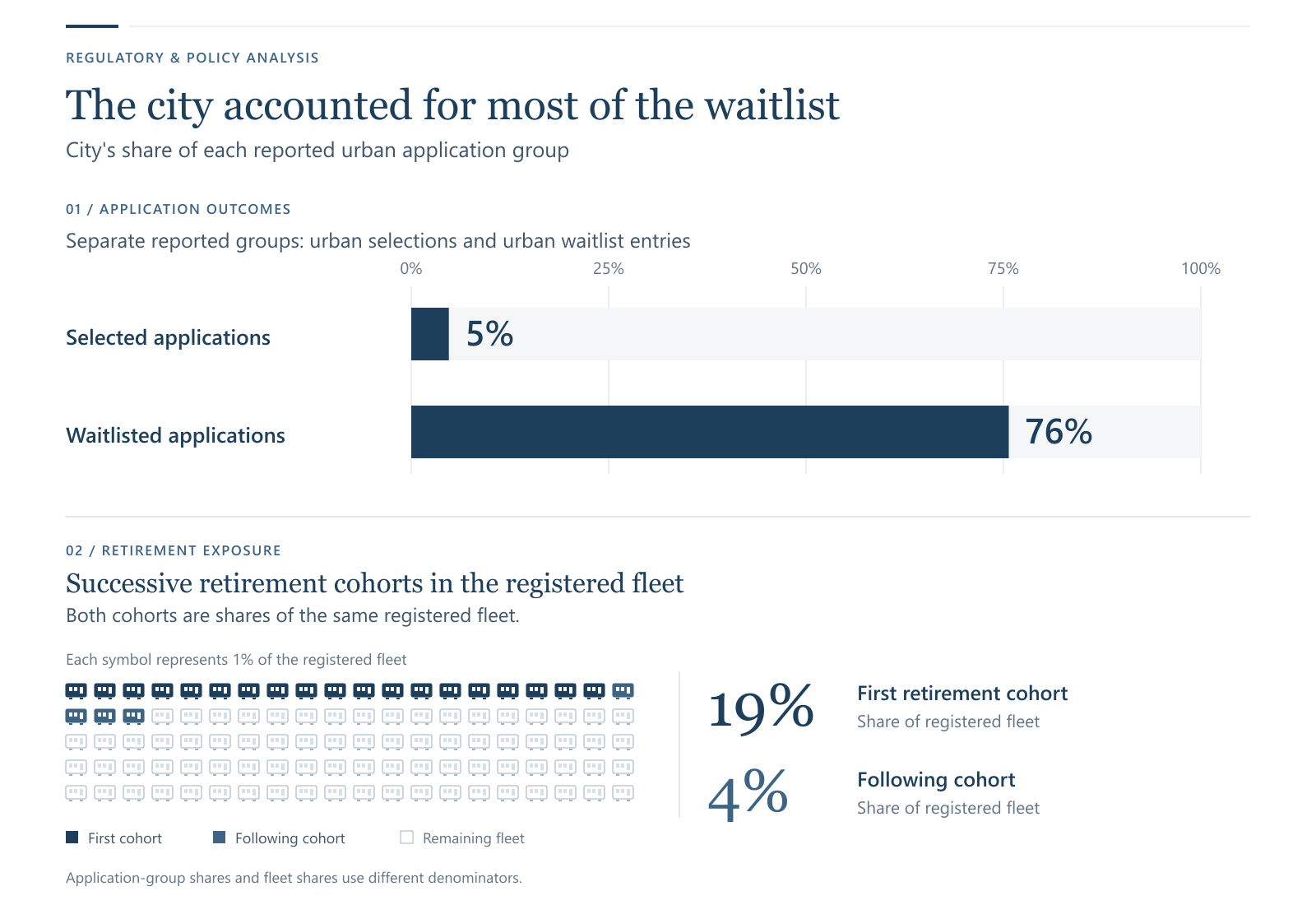
Fleet replacement subsidy priorities: the city accounts for about 5 percent of reported urban selections and 76 percent of urban waitlist entries. The first retirement cohort represents 19 percent of its registered fleet and the following cohort 4 percent. The groups use different denominators. View full size

Site Acquisition Due Diligence

Zoning, Land-Use & Development Feasibility

Mandate

Retained by a prospective bidder for a transit contract to determine whether it could build the required infrastructure on sites under consideration for acquisition.

Outcome

The findings enabled the client to withdraw from negotiations to acquire the sites without penalty and redirect its search toward a site where zoning permitted the proposed facility.

Analysis

Reviewed municipal certificates documenting applicable zoning requirements, property title records, and relevant case law to establish that the zoning rules did not permit the proposed facility. For two additional parcels, identified environmental protection and flood hazard restrictions that prohibited the proposed use. Prepared a memorandum combining legal and technical analysis to establish that pursuing the available administrative remedies would take longer than the construction schedule allowed.

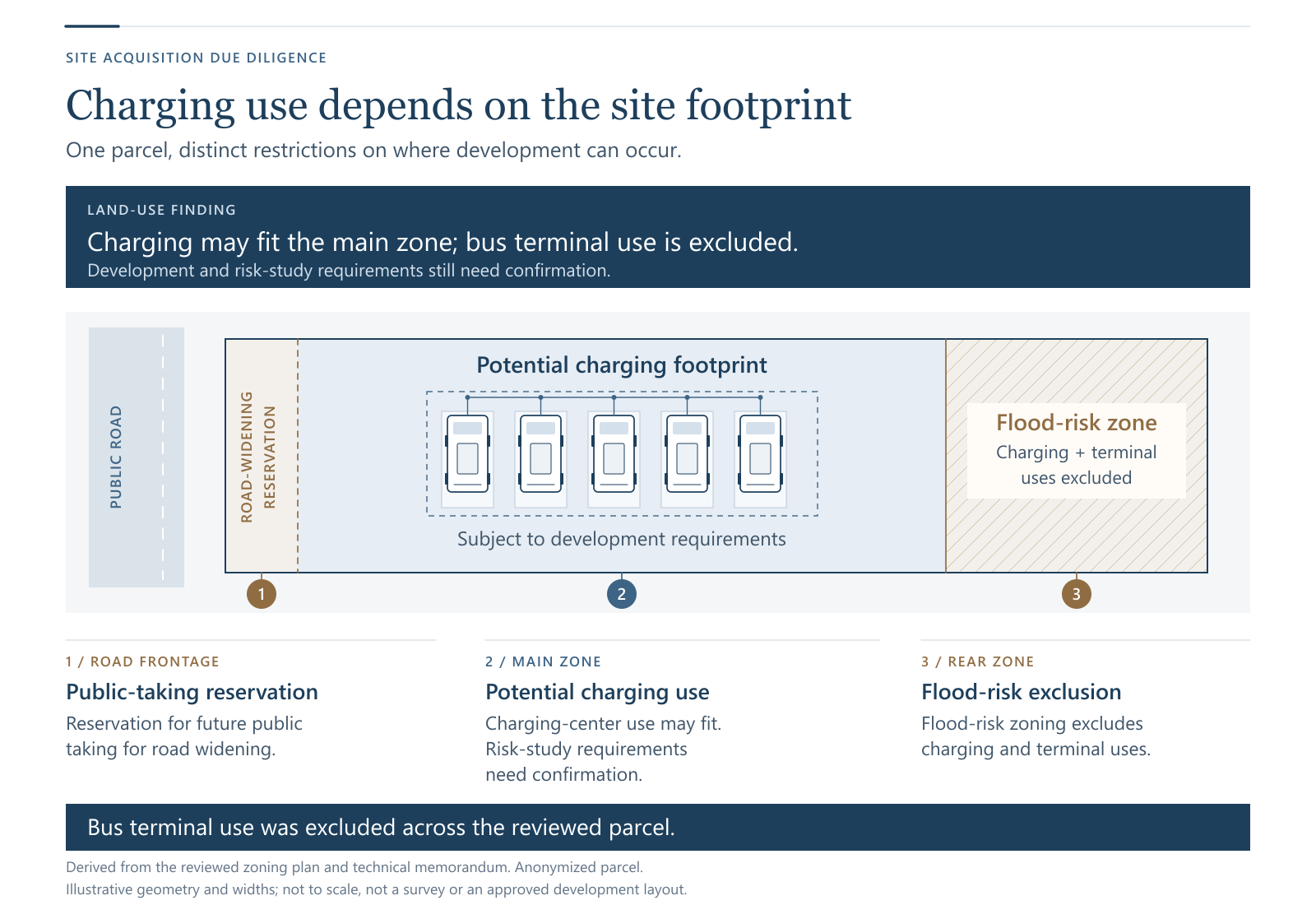
Land-use constraints schematic of a conceptual parcel: a road-widening reservation at the frontage, a main zone potentially permitting a charging center, and a rear flood-risk zone excluding both charging and terminal use. Not a survey. View full size